Financial Fraud Detection - Autoencoder System
Production ML - Anomaly Detection
Production-level autoencoder anomaly detection model for financial fraud, designed with leakage-safe training pipelines and extreme class imbalance handling.
Problem
Under 1% of transactions are fraudulent, so a classifier that predicts 'legitimate' every time is already 99% accurate and completely worthless. The metric everyone reaches for is actively misleading here.
Approach
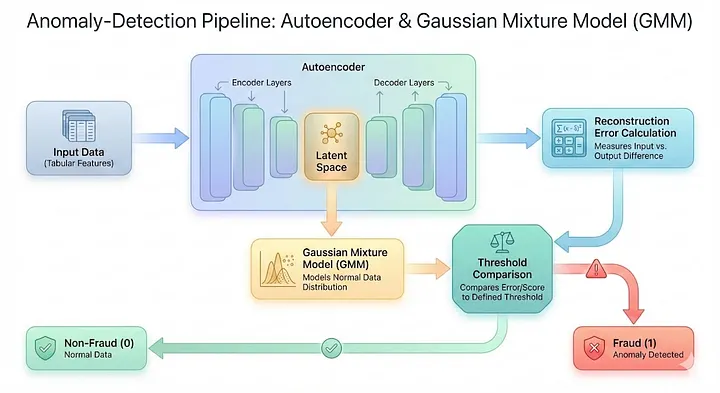
Rather than fitting to rare labelled fraud, an autoencoder learns what normal transaction behaviour looks like and flags what it cannot reconstruct. The training pipeline is leakage-safe so the model never sees information it would not have at prediction time.
Trade-off
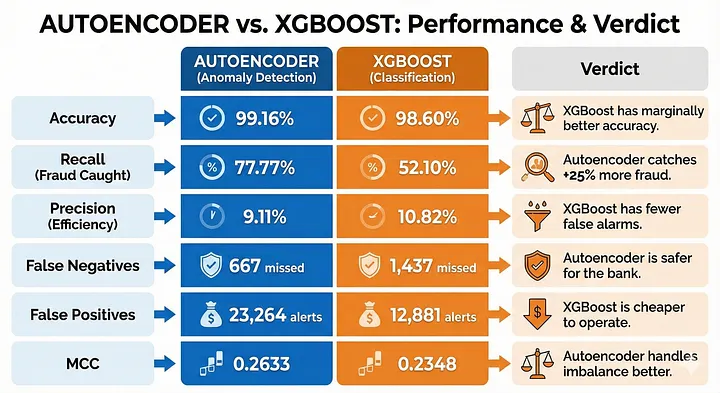
Anomaly detection over a supervised XGBoost baseline, despite supervised models being the obvious first reach. Learning normal behaviour generalises to fraud patterns absent from the training labels, which matters when fraud changes shape faster than a labelled dataset can.
Architecture
Modelled normal transaction behaviour for a dataset with under 1% fraud rate, improving recall by 25% versus an XGBoost baseline. Tuned decision thresholds to flag fraud at 95% confidence, capturing up to 99% of total fraud losses while minimising false investigations.
Results
25% better recall than the XGBoost baseline. Tuning the decision threshold to flag at 95% confidence captured up to 99% of total fraud losses while keeping false investigations low, because the cost of the two errors is nowhere near symmetric.
Highlights
- Leakage-safe training
- Extreme imbalance handling
- Loss-impact evaluation
Technologies
- Python
- TensorFlow
- Autoencoder
- XGBoost
- MLOps
Screenshots